






Executive protection is changing, and fast. Installers and integrators are being pulled into a space that has traditionally belonged to government agencies, but the rules, risks and resources are different.
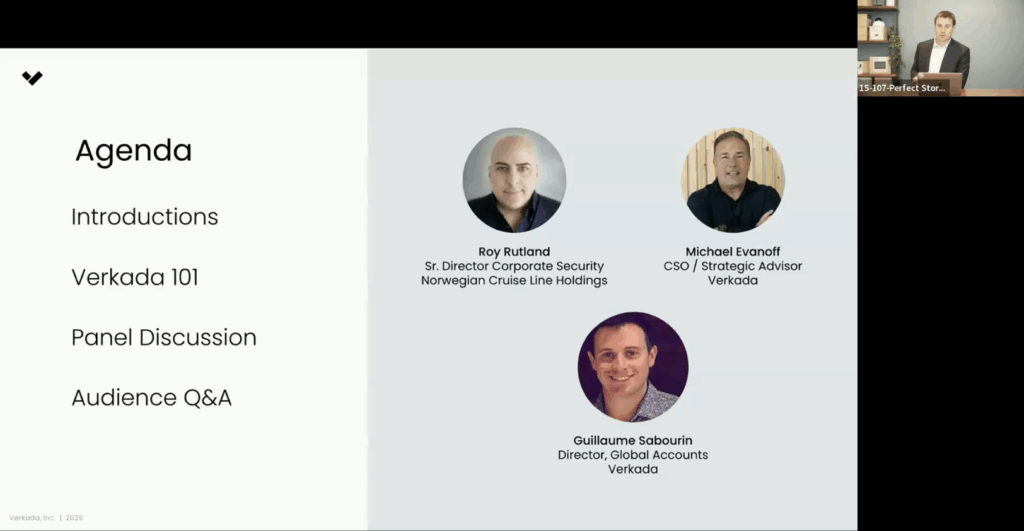
In a recent webinar entitled: ‘EMEA Beyond Bodyguarding: How Global Enterprises are Using Cloud and AI to Rethink Executive Protection’ and hosted by Verkada, we heard from Roy, Senior Director of Corporate Security at Norwegian Cruise Line Holdings and a veteran of the Miami-Dade Police, alongside Mike Evanoff, Verkada’s Chief Security Officer and a former Assistant Secretary of State for Diplomatic Security. The webinar, chaired by Guillaume Sabourin from Verkada, discussed how global enterprises are using cloud and AI to rethink executive protection.
The presenters delivered a wake-up call for security integrators and installers looking to support executive protection (EP) programmes in the private sector.
Their message was clear: the executive protection landscape is changing, and so are the expectations around technology.
Budget Pressure, Real Threats
The market for executive protection has evolved in response to high-profile security incidents involving business leaders, celebrities and government officials. But while the threat environment is catching up to what government agencies have long dealt with, corporate budgets haven’t.
“You have to ask yourself, is having an EP team corporate mission critical?” Roy asked during the session. “If the answer is no, then you may want to examine that recent shooting in New York City closely. I believe that shooting answers that question.”
Still, unlike the seemingly limitless resources of the Secret Service or the Diplomatic Security Service, private organisations are expected to defend their leaders with a fraction of the funding. “Corporate security is a black hole,” Roy said. “You’re not generating revenue—you’re spending it.”
This tension puts integrators in a pivotal role. Security systems must deliver government-level capabilities without the government-level budget.
Smarter Systems, Smaller Teams
The good news for integrators is that technology is catching up. The days of vast public-sector-only capabilities are behind us. “The ability to have refined facial recognition, read a license plate going 80 miles per hour, and backstop that with databases—that gap between government and the private sector is almost gone,” Evanoff explained.
But tech on its own isn’t enough. The real challenge is tailoring solutions to fit the unique context of EP. That means designing systems that extend the reach of smaller teams and support mobility, adaptability and intelligence-led decision-making.
Roy pointed to his own experience developing “R2″—a rapidly deployable solution that streams live audio and video to an operations centre from any location. It’s not just a tool—it’s a force multiplier. “If you can’t build a large enough team, then you’re just bodyguarding,” he said. “You need technology to give your operators reach.”
Reach is critical—not only for travel and events, but also for protecting residences. The recent incident at the Pennsylvania governor’s mansion was a stark reminder of what happens when perimeter detection systems are out of date or disabled due to false alarms. “Somebody climbed the fence, walked the grounds… and nothing went off,” Evanoff said. “It was old kit that didn’t work.”
Integration is the Differentiator
If there’s one area where integrators can set themselves apart, it’s in their ability to tie systems together. Executive protection today demands more than standalone CCTV or alarms. The most effective systems are those that interface with threat intelligence platforms, operations centres, and even local law enforcement.
“You have to start with intelligence,” said Roy. That means helping clients understand their risk landscape before cameras are even mounted. Platforms like OSAC and DSAC are standard reference points in government, but are still underused in corporate environments. Integrators who can bridge that knowledge gap bring added value.
Flexibility is also key. Systems must be modular and mobile, ready to deploy in different environments—from executive homes to public speaking venues to travel scenarios. And increasingly, organisations are looking to standardise EP practices across teams and geographies. Groups like Executive Protection Professionals (EP2) are pushing this forward, offering guidelines that integrators can align with.
But above all, the role of people remains central. “It’s the person in the right front seat,” Evanoff said, “but more importantly, it’s the advance—your eyes on the ground ahead of you.”
Executive protection isn’t just a market segment—it’s a mindset. And it’s growing fast. With corporate boards more aware of personal risk than ever, and with new technologies enabling the delivery of government-grade capabilities at a commercial scale, the opportunity for security integrators is clear.
The question isn’t whether there’s demand. The question is whether the industry is ready to deliver smartly, flexibly, and with a deep understanding of what’s truly at stake.