
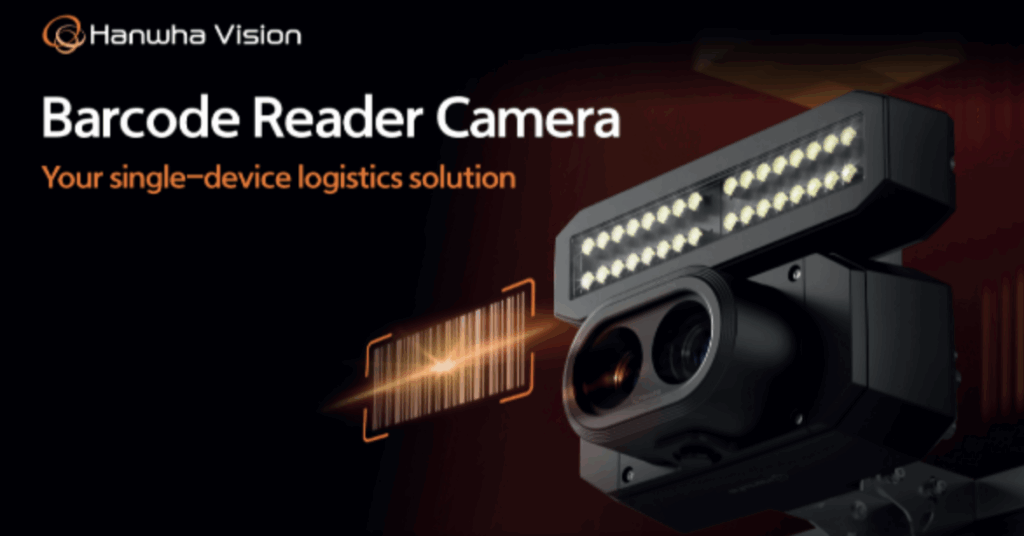
Hanwha has introduced a device that invites a closer look at how logistics environments can streamline their operations without adding layers of hardware. Its new dual-sensor Barcode Reader Camera, available in models TNS-9040IBC, TNS-9050IBC and TNS-9060IBC, brings together two functions that usually sit metres apart on a conveyor line. Bringing barcode capture and video surveillance into one unit isn’t just a matter of convenience – it reshapes how operators can track, verify and investigate parcel movement in real time.
The camera’s design hinges on a paired sensor approach: a monochrome channel dedicated to barcode label detection, supported by AI to pinpoint labels quickly, and a 4K colour channel for video monitoring. That blend means the device does more than read labels. It provides context around every scan, giving teams a clearer view of operational flow and supporting root-cause analysis when something goes astray.
Hanwha Vision positions the unit as a cost-oriented alternative to conventional set-ups. Where separate barcode readers and surveillance cameras call for multiple mounts, power feeds and maintenance cycles, a single device reduces the physical footprint and simplifies the job for integrators. It also pares back the sort of cabling complexity that tends to grow with scale.
Speed is a central concern in most logistics halls, and the incorporation of a global shutter on both channels ensures that even high-velocity parcels are captured without distortion. Lens options of 16, 25 or 35mm give installers the flexibility to work with wide bays, compact chutes or dense sorting lines.
Durability has clearly been a priority. With IP66/67 and IK10 ratings, plus M12 connectors, the camera is built for the dust, vibration and hard knocks that come with a busy warehouse. Operators looking to centralise tracking will also appreciate how the device fits into Hanwha’s broader ecosystem. It acts as a front-end component for Vision Logistics Tracking Software, which provides a top-level view of item movement and performance trends across the operation.
Beyond its technical specifications, the real value lies in how the camera supports daily logistics decisions. Real-time parcel tracking can help reduce shipping errors and unnecessary returns, tighten compliance processes and speed up incident investigations. For organisations under pressure to demonstrate accuracy and transparency, that combination of data and visual confirmation becomes a practical advantage.