
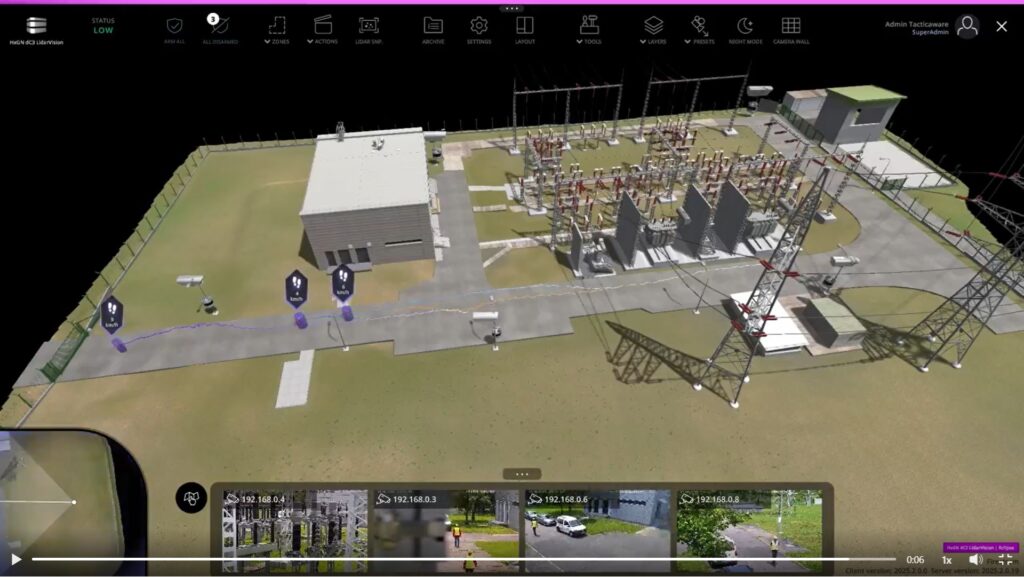
Czech energy distributor EG.D, part of the E.ON group, has launched a pilot project using Hexagon’s HxGN dC3 LidarVision to enhance security and operational safety at one of its high-voltage substations. The initiative comes amid growing electricity demand and tightening EU regulations concerning the resilience of critical infrastructure.
The project explores how 3D volumetric detection using LiDAR can improve visibility across complex, unmanned substation environments. Traditional perimeter security, which typically relies on fencing, PIR sensors and CCTV, is increasingly seen as limited in scope. EG.D’s goal was to evaluate how real-time spatial awareness and flexible zone control could mitigate risks — both from unauthorised intrusion and from maintenance-related hazards.
The pilot system uses five LiDAR sensors to create virtual secure zones that are customisable at any time via software controls. During maintenance, for instance, specific zones can be temporarily deactivated while the rest of the site remains monitored. This adaptive approach provides improved safety for engineers and contractors working near live equipment, while still maintaining an active barrier against unauthorised access elsewhere.
The HxGN dC3 LidarVision platform feeds data back to EG.D’s control centre in real time, tracking movement, location, speed, and projected direction of individuals on site. The system can also be integrated with cameras, alarms and speakers to provide situational awareness and communication in the event of a breach or emergency.
One of the notable outcomes of the pilot is the creation of a digital twin for the substation. This interactive 3D model allows the company to simulate intrusion or failure scenarios, test mitigation strategies, and optimise sensor placement. The inclusion of thermal sensors further supports early detection of overheating components or wildlife incursions before they escalate.
Tomáš Sofka, from EG.D’s security technologies team, said the decision to partner with Hexagon was based on a long-standing relationship and confidence in their spatial technology capabilities. Following positive internal feedback, the pilot is now being positioned as a model for wider adoption across the grid. EG.D has begun knowledge-sharing with other utilities across Europe, the US, and Asia-Pacific.
This project aligns with upcoming legislative requirements, such as the EU’s Critical Entities Resilience (CER) Directive, set to take effect in July 2026, and Germany’s KRITIS regulations. It also responds to operational concerns raised earlier this year, when a substation fire in the UK disrupted power to thousands of homes and an airport.
EG.D’s approach signals a shift in how utility providers are beginning to reframe physical security, moving from static deterrence to dynamic, data-led site awareness.