
The 24-month mobilisation period for Martyn’s Law is now well underway, and the security industry is beginning to face what this means in practice. To help address the operational and compliance questions now arising, Benchmark and System Q hosted a follow-up webinar on 7 October titled Martyn’s Law Compliance: Your Questions Answered – Practical Implementation Strategies.
Led by Mike Isherwood, Managing Director of System Q, the CPD-accredited session built on the strong engagement from the first webinar earlier in the summer. That initial session covered the fundamentals of Martyn’s Law and its two-tier system, but it also revealed how much practical guidance the industry still needed. Installers and venue managers wanted clarity on fluctuating capacities, outdoor and temporary events, and the safe integration of fire and security systems.
In this second session, Isherwood went straight to the heart of these issues. He began by clarifying that the sector is in a mobilisation phase, not a waiting period. The Bill received Royal Assent in April 2025, meaning full compliance is required by April 2027. Statutory guidance will be published over the next year, but venues should already be conducting assessments and allocating budgets. “It’s a 24-month mobilisation period, not a 24-month enforcement delay,” Isherwood said, noting that early action will protect both safety and business continuity.
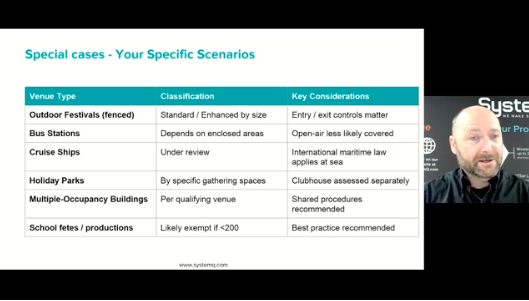
Using real examples, he explained how venues should determine their tier classification. A restaurant might be Standard Tier during the week and exceed the threshold at weekends, while a garden centre running large seasonal events could temporarily qualify as Enhanced Tier. The guiding principle, he said, is “reasonable expected attendance” rather than fixed capacity. Special cases such as bus stations, cruise terminals and holiday parks remain subject to developing guidance, but all should be assessing foreseeable risks now.
Another key topic was the so-called “under-200 vulnerability gap”. Although smaller venues are outside the legal scope of the law, they are not immune to threat. Isherwood shared figures showing that 40 per cent of recent attacks took place at smaller venues. He urged these operators to voluntarily adopt basic Standard Tier procedures such as evacuation plans, staff training and clear communication methods. These steps cost little yet significantly improve resilience and, in many cases, reduce insurance premiums.
Practical Challenges and the Road Ahead
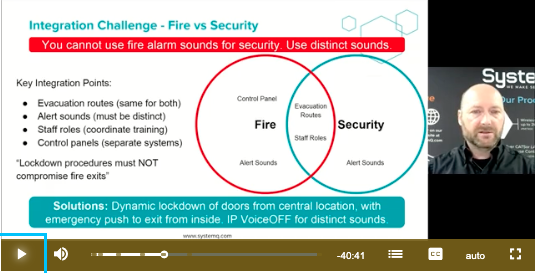
The session also addressed one of the most complex issues from the previous webinar: the integration of fire and security systems. Isherwood emphasised that lockdown procedures must never compromise fire safety and that distinct alerts are essential. “You cannot use fire alarm sounds for security,” he explained. The recommended solution is to use dynamic lockdown controls that can be overridden internally, supported by clear voice alerts. System Q’s VoiceOFF range was presented as one example of how to achieve this safely and effectively.
Throughout the session, Isherwood challenged some of the misconceptions circulating in the market. There is currently no such thing as a ‘Martyn’s Law approved’ product, and AI cameras are not mandatory for Enhanced Tier venues. Standard CCTV remains sufficient as long as it meets British Standards and NDAA compliance. He also reassured attendees that GDPR concerns are straightforward: legitimate security monitoring qualifies as a legitimate interest under data protection law, provided privacy notices are kept up to date.
Funding remains a concern for many venues. Isherwood confirmed that there is no dedicated government fund for Martyn’s Law compliance, though alternative sources exist, such as the Safer Streets Fund and local Police Property Act grants. He also noted that compliant venues can often achieve insurance reductions of between 15 and 30 per cent, offsetting investment costs within three years.
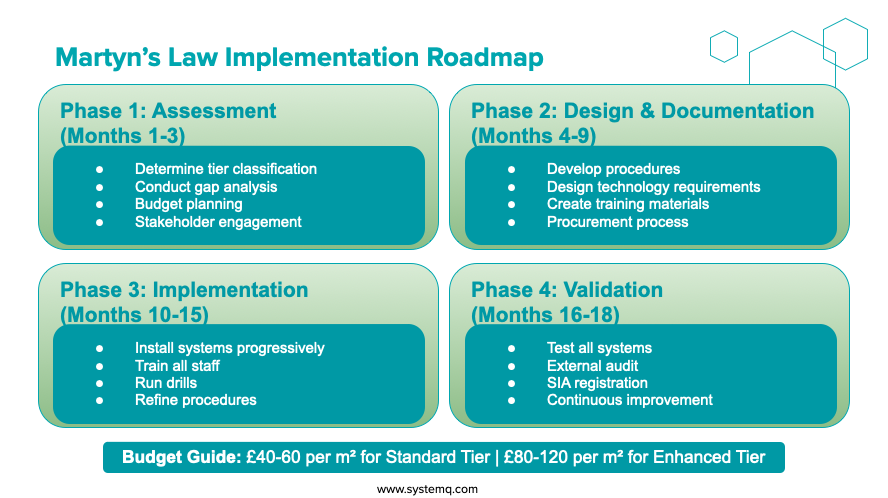
To help organisations structure their preparations, System Q shared an 18-month implementation roadmap covering assessment, design, implementation and validation phases. This practical framework allows venues to build compliance in stages, beginning with a gap analysis and budget plan, followed by the development of procedures, system upgrades and final testing.
Two real-world examples demonstrated how early action pays off. A 3,000-student academy achieved a 25 per cent insurance reduction and improved Ofsted feedback after upgrading its CCTV and access control. A shopping centre with 50 independent retailers implemented unified procedures and a central cloud command system, reaching cost neutrality by the second year.
The session concluded with a clear call to action: start now, prioritise procedures before technology, and document everything. “This is about saving lives, not just ticking boxes,” Isherwood said.
To support the industry, System Q is offering free guides for installers and venue operators, along with consultation and design-review services, available at www.systemq.com.
The webinar can be watched on demand here.