
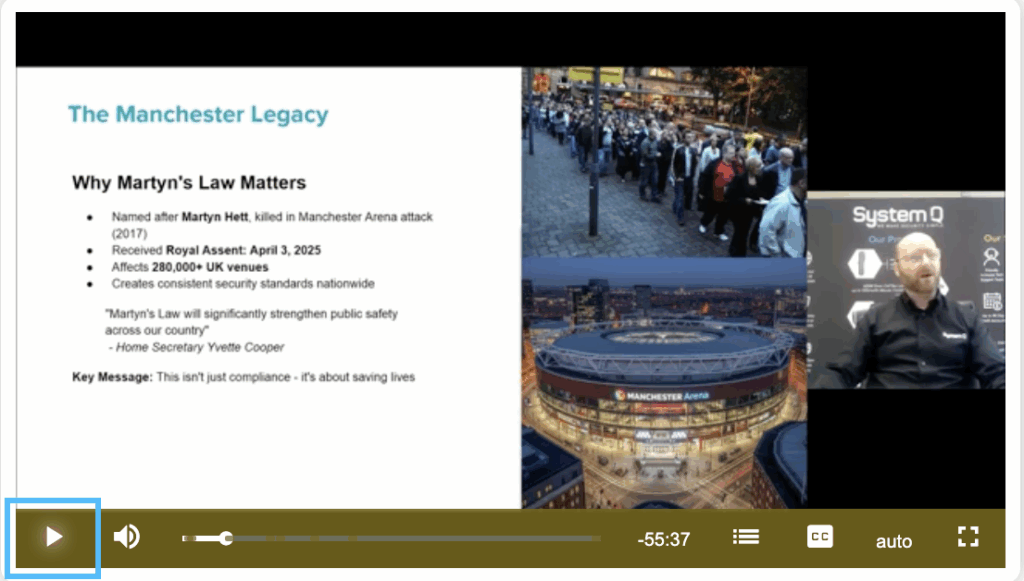
Three months on from Royal Assent, Martyn’s Law is already raising big questions for the UK’s security industry. Yes, there is a 24-month mobilisation period now underway to make sure that measures are taken, but this time will go fast, and action needs to be taken now.
The CPD-accredited webinar organised by Benchmark and presented by Mike Isherwood, Managing Director of System Q, attracted security professionals from a wide range of sectors—many of whom came armed with pressing questions about what the legislation means in practice, how to interpret it across different venue types, and what role technology should (or shouldn’t) play in meeting the new requirements.
Opening the session, Mike highlighted the scale of the challenge. Over 280,000 venues across the UK will need to comply with Martyn’s Law, which was passed in honour of Martyn Hett, one of the victims of the 2017 Manchester Arena attack. The legislation, he said, is about introducing “consistent security standards nationwide.”
At the heart of the law is a two-tier system:
- Standard tier (200–799 capacity): Around 279,000 venues fall into this category—mainly retail and hospitality (65%), places of worship (16%), and schools (11%).
- Enhanced tier (800+): This applies to larger entertainment venues, stadiums, and retail centres.
“This isn’t just compliance—it’s about saving lives,” said Isherwood, echoing Home Secretary Yvette Cooper’s view that the law will “significantly strengthen public safety across our country.”
What’s required – and when?
Mike walked attendees through the key responsibilities for each tier. For the standard tier, venues must implement four key response procedures – evacuation, invacuation, lockdown, and communication – alongside staff awareness training and SIA registration.
Technology isn’t mandatory here, but it can support planning and response.
Enhanced venues, by contrast, have more substantial obligations. These include appointing a senior responsible person at director level, conducting comprehensive public protection risk assessments, and putting in place physical measures such as CCTV, barriers, and safety glass. For this tier, said Isherwood, “the right technology is required.”
The timeline is clear: statutory guidance is being developed through 2025–2026, full implementation is expected by April 2027, and enforcement begins thereafter. Fines will start at £10,000 for standard tier venues, rising to £18 million—or 5% of turnover—for those in the enhanced category.
Attendees raise practical concerns
Throughout the webinar, attendees submitted thoughtful and often complex questions that reflected the real-world implications of Martyn’s Law across different environments. While the core principles are clear, many details remain open to interpretation.
Webinar attendees had questions about how venues should be classified, particularly those with fluctuating capacity. Mike explained that classification is based on “reasonable expected attendance,” meaning the higher weekend figure would apply. Also he highlighted that the calculation of the capacity, should include all staff.
Some scenarios are harder to define. One example involved a garden centre that hosts a Christmas market attracting more than 800 people over just two days a year. While standard tier seemed appropriate for most of the year, it wasn’t clear whether a temporary capacity spike would shift the venue into enhanced tier status. These types of seasonal or event-based exceptions remained unanswered.
Education, transport and maritime sectors
Schools fall into the standard tier regardless of size, confirmed Mike – meaning even large academy trusts will need to implement the four core procedures and ensure SIA registration. One attendee from a trust responsible for over 24,000 students and 3,000 staff asked about lockdown alarms and compliance costs under tight public sector budgets.
The transport sector added another layer of complexity. Although existing secured transport hubs are exempt, there were questions about whether new-build stations or smaller regional hubs would qualify. Maritime venues, such as cruise ships and port-based events, also drew attention, with attendees asking how Martyn’s Law interacts with maritime security law. These remain grey areas.
Questions also emerged around events, festivals, and pop-ups. If an event organiser hires a venue for a day, who is ultimately responsible for compliance, the organiser or the venue? This led to wider discussion about how Martyn’s Law will apply to temporary spaces and shared sites.
Attendees were keen to understand what kind of technology is “compliant,” especially in the enhanced tier. Facial recognition sparked concern. “We’re worried about privacy and GDPR—does this mean facial recognition will be required?” one person asked. Mike warned about claims of ‘Martyn Law’ ready product. He said there is not such a thing.
Mike outlined how AI-driven technologies—including people counting, object recognition, and perimeter detection—can support compliance. He noted that System Q offers support with BS 9347 Facial Recognition Technology guidance. However, the privacy-versus-security balance remains a key issue for many operators.
Integration was another theme. Several attendees asked whether new security systems must interoperate with fire alarms, PA systems or building management tools. These questions suggest a need for clearer technical standards.
Market opportunity—and an urgent call to action
For security professionals, the legislation represents a clear opportunity. Mike estimated standard tier systems could generate £2,000–£10,000 per venue, while enhanced sites could range from £10,000 to over £100,000 depending on complexity.
To help installers get started, System Q is offering free consultancy on the first five Martyn’s Law projects, plus support with system design, compliance documentation and product selection. Training sessions are also in development.
The session showed just how ready the security industry is to engage with Martyn’s Law—but also how much clarity is still needed. Isherwood’s message was clear: start now, because demand is already ramping up.
Yet as the conversation revealed, success will depend on more than early action. Clearer guidance, closer collaboration, and a shared understanding of how to apply this legislation across thousands of unique settings will be key in the run-up to 2027.
You can watch the CPD webinar on demand here by just entering your details.
If you would like to download System Q’s PDF guide, please follow this link: https://systemq.com/martyns-law-installers-guide/