
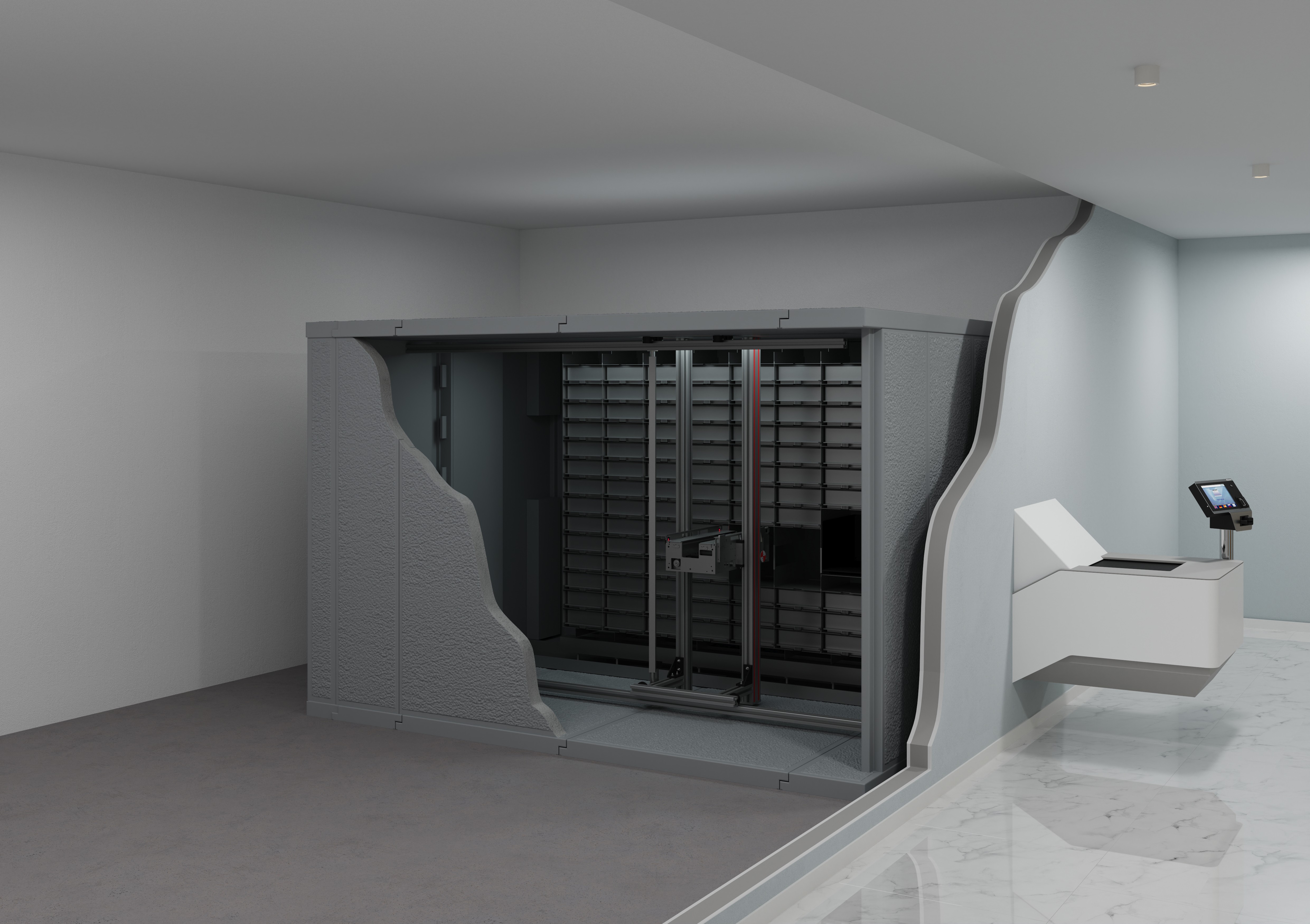
The safe deposit locker as a solution has been characterised by continuity rather than disruption. The fundamentals have remained largely unchanged: a physical asset, secured within a controlled environment, accessed under tightly managed conditions.
The value of the system lay in its strength and its predictability. Customers understood where responsibility lay, operators understood how access was governed and risk was mitigated through legislation, human oversight and clearly defined procedures.
This is now changing, says Emmanuel Harir-Forouch, Global Business Development Director – Vaults, SafeStore Auto & Safe Deposit Lockers of Gunnebo Safe Storage. As broader consumer behaviour shifts toward self-service, continuous availability and digitally mediated interaction, safe storage is working with the evolution of smart buildings and the connected built environment. Expectations of twenty-four-hour access, minimal friction and remote interaction are becoming normalised and expected by discerning consumers.
The challenge is to integrate the latest security technology and how to do so without eroding the principles on safe storage. Automation, software driven management and digital identity systems offer compelling operational benefits. Yet they also force the industry to confront deeper questions around oversight, accountability and trust.
Automation, Autonomy and the Question of Oversight
One of the most significant shifts is the gradual removal of human mediation. In traditional models, staff played an explicit role in identity verification, access control and exception handling. As systems move toward unattended operation, such responsibilities are redistributed across hardware, software and predefined rules.
When access decisions are automated, where does authority reside, and how is it exercised when conditions fall outside expected parameters? Automated systems can respond consistently, but consistency is not the same as judgement. The absence of on-site personnel places greater weight on system design, exception thresholds and escalation mechanisms.
Digital identity illustrates this tension. Biometric authentication, encrypted credentials and time limited access codes simplify access and reduce operational friction, but they also shift trust away from people and procedures and toward technology and data integrity.
Failures in this context have different implications. Errors or breaches are no longer isolated to a single interaction but can potentially scale across systems and sites.
From a technical perspective, safe storage is also no longer a single layer problem. It is an interconnected system where physical barriers, software platforms, identity management, access control, often remote and monitoring tools must operate coherently. A weakness at any layer can undermine the whole.
This raises the issue of how responsibility can be defined in environments where security outcomes depend on complex system interactions rather than direct human supervision.
Governance, Compliance and System Resilience
As safe storage becomes more digitally managed, oversight increasingly takes the form of data. Operators now expect real time visibility into locker usage, access events and system health, particularly in multi-site environments
Compliance adds another layer of complexity, where digitally mediated access generates extensive records, from authentication attempts to configuration changes. Standards must reflect latest manipulation techniques and proactively deter from digital threats.
These records can support auditability and regulatory alignment if systems are designed with clarity and consistency. Poorly structured data can be as problematic as no data at all, obscuring accountability rather than reinforcing it.
Resilience is perhaps the most critical and least visible concern when it comes to security and fire safety. Automated and connected systems depend on power, connectivity and software integrity where safe storage environments cannot simply go offline in the event of disruption. Core security functions must continue to operate predictably.
This emphasis on resilience reinforces the ongoing importance of physical infrastructure. Despite growing digitisation, safe storage relies on material strength, precision engineering and controlled environments. Digital layers should reinforce these fundamentals and decisions around modularity, footprint and material efficiency must be evaluated against long term durability and evolving threat models, not short-term convenience.
Retrofitting existing facilities is one option. Many safe storage sites were not designed or installed for networked systems or remote management. Constraints around space, power and layout force compromises that cannot be resolved through software alone. Progress tends to be incremental, demanding solutions that are scalable and adaptable without being disruptive.
Rebalancing Trust in a Digitally Mediated Environment
From the user perspective, the experience of safe storage is also changing. Self-service systems offer greater privacy and flexibility but places a responsibility on system designers and operators to ensure simplicity at the interface. An intuitive user experience must be underpinned by robust governance, monitoring and response capabilities, available remotely) that users never need to encounter directly.
Taken together, these developments suggest the future of safe storage will be shaped less by individual features than by how well systems manage in digital security environments where convenience must be balanced against control. Automation must coexist with accountability and flexibility must not compromise assurance.
Gunnebo Safe Storage invests in research and development of safe storage as an ecosystem. Physical infrastructure, digital management, operational policy and human oversight all remain essential, even if their roles are evolving. The task is to reinterpret solutions for an environment where connectivity and self-service are the norm.
Gunnebo Safe Storage’s SafeStore Auto is designed for this new landscape. An advanced, fully automated safe deposit locker system that brings together autonomous access, intelligent technology, and smart design in one integrated platform.
At the heart of SafeStore Auto is a frictionless self-service experience. Users can access their lockers independently, at any time, using a combination of biometric authentication, encrypted card readers, PIN codes, and one-time digital passcodes. The interaction is quick, secure and fully staff-free, enabling greater privacy and convenience without compromising on safety.
This autonomy is supported by SafeControl Manager, Gunnebo Safe Storage’s dedicated software platform that manages everything from identity verification to system health and user permissions. Operators can tailor access rules, monitor locker usage in real time, and respond instantly to irregular activity – all through a centralised interface.
Taken together, these shifts point to a sector in transition, where safe storage is being shaped by the same forces influencing wider smart building and security ecosystems.
As systems become more autonomous and digitally managed, the emphasis moves toward how physical infrastructure, software oversight and operational practice work in combination. The ability to deliver secure and connect reliable storage now rests on aligning these elements so that access remains controlled, resilience is maintained and responsibility remains clear, even as user expectations continue to evolve.