




The conversation in the security industry is changing from cloud to AI. At least, that was the underlying message from the VerkadaOne annual event held in Chicago in September. This wasn’t simply a showcase of new technology but a reflection of how quickly the focus is moving towards systems that think and act with human-like reasoning.
From the Industrial Age to the Cognitive Era
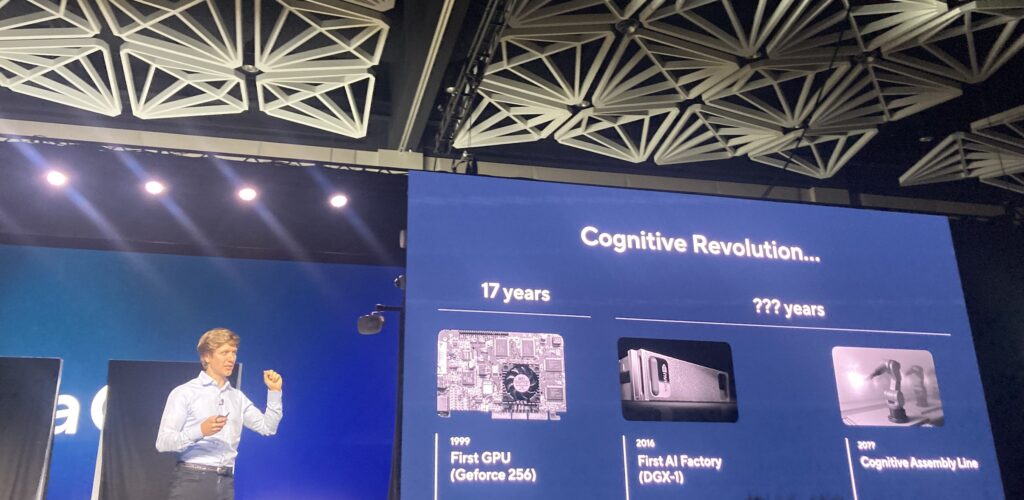
A very interesting talk at the event came from Konstantine Buhler, who framed the rise of AI as the modern equivalent of the Industrial Revolution. He reminded the audience that the first steam engine was built in the early 1700s, but it took decades for factories to emerge. By 1769, James Watt’s design had set the foundation for industrial growth, and by 1913, Ford’s assembly line marked another leap in human progress. Borel called this long process the ‘specialisation imperative’. Today, he said, we are entering a new phase – the ‘cognitive revolution’.
To make the point, he showed a simple timeline: 1999 saw the first GPU, which enabled the computing power we rely on today; 2016 marked the first wave of practical AI breakthroughs. His argument was that the hardware and data foundations are now in place, and the real progress will come from systems that act independently rather than wait for human input.
Shifting AI as a co-pilot to AI as an operator
Konstantine Buhler, Partner at Sequoia Capital and a long-time investor in Verkada, expanded on this theme. He has worked closely with the company for more than six years and sees Verkada as a clear example of how AI is reshaping the physical security landscape. Buhler described the company as part of a broader shift where businesses build ‘always-on’ systems that never sleep, creating a new kind of operational model.
He spoke about what he calls ‘agentic AI’ – systems that don’t just advise but take action. In security, that means AI tools capable of detecting, reasoning and responding. Instead of simply raising an alert when something looks suspicious, the system can lock a door, notify staff and log the event automatically. This shift from reactive monitoring to proactive decision-making is changing how we think about protection and safety.
Buhler also highlighted Verkada’s ability to combine accessible, plug-and-play hardware with powerful, cloud-based software. That balance, he said, is rare and difficult to replicate. Following the event, he commented on the ‘sheer velocity of new products’ unveiled, including expanded AI alerts and a redesigned Operator View. For him, these announcements show a company committed to continuous improvement through innovation.
Beyond Intelligence: Building Trust and Value
From a market perspective, the scale of change is hard to ignore. Analysts predict that the global market for AI could exceed $3.6 trillion by 2034, with sectors such as healthcare, finance and technology leading adoption. Physical security is fast joining that wave. But as Buhler pointed out, success will depend on more than adding AI on top of existing systems. The business model itself is evolving.
He explained that the traditional approach of selling licences or ‘seats’ is giving way to value-based models. In his words, “The future of AI isn’t only about intelligence – it’s about impact.” Companies are now looking at how AI contributes directly to measurable results, whether through automation, reduced response times or improved operational insight.
The discussion also touched on the challenges ahead. AI systems still need better memory and stronger communication frameworks to interact seamlessly. As Borel noted, we may soon need an equivalent of TCP/IP for AI – a protocol that allows intelligent systems to communicate securely and efficiently. Building trust models for large language models, delivery networks, and end users will be essential if AI is to achieve its full potential.
For physical security professionals, these developments are not theoretical. The move from cloud to cognition is already underway. Devices and sensors are becoming smarter, able to interpret and act on information in real time. The most successful companies will be those that design systems capable of independent reasoning, while maintaining transparency and control for users.
Some of Borel’s historical comparisons may invite debate – the Industrial Revolution’s timeline can be interpreted in many ways – but the analogy holds. Just as steam power transformed production, AI is transforming perception and decision-making. It took generations for the industrial age to mature; the cognitive era will likely unfold much faster.
VerkadaOne left a strong impression of a company, and indeed an industry, in motion. The conversation has moved beyond what the cloud can store or analyse to what AI can decide and do. Systems are shifting from assistance to action, and the pace of change is accelerating. For those of us following the evolution of physical security, the message from Chicago was clear: intelligence is no longer about data – it’s about what happens next.