






Chicago’s Marriott Marquis was transformed yesterday into something closer to a concert hall than a conference venue, as Verkada opened its three-day VerkadaOne event to an audience of more than 2,000 IT and physical security leaders. Running until Wednesday, the gathering has brought together customers, partners and industry leaders to hear where the company is heading. High-impact video sequences, theatrical lighting and polished delivery gave the event a slick energy.
Striking video backdrops, crisp lighting and seamless production gave the sessions a polished edge, but the emphasis remained on substance. The day went by very fast thanks to the keynote speakers delivering their sessions with the confidence of people who know their products inside out.
The production values matched the message. This was not about cloud security being new or disruptive – that was Verkada’s birth story nine years ago. The point now, reinforced throughout the day, is that AI has become the frontier for physical security.
Shifting the Narrative
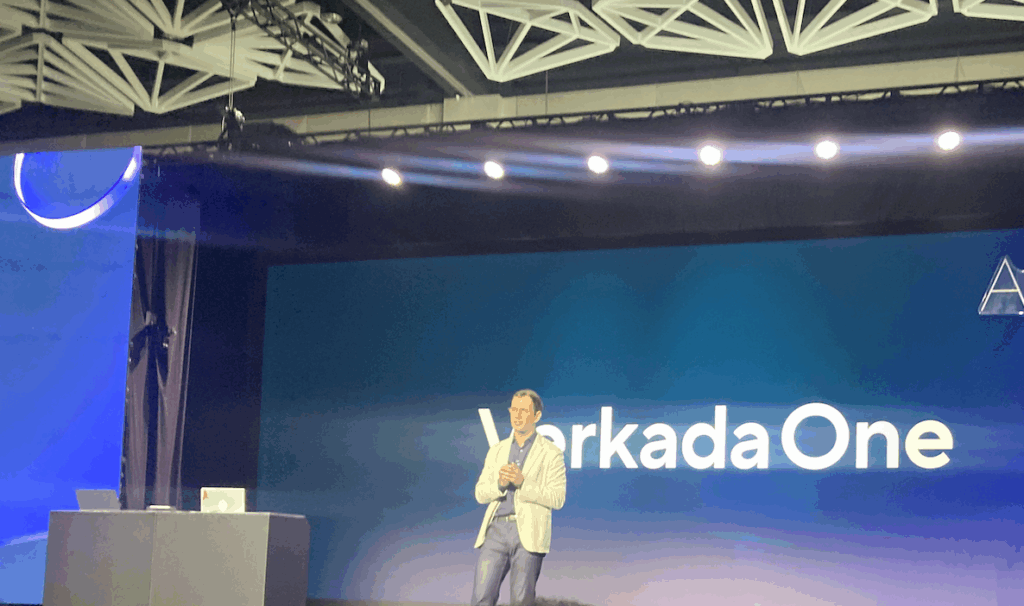
Opening the keynote, CEO Filip Kaliszan (pictured right) looked back on Verkada’s journey, reminding the audience that cloud-native was once a differentiator but is now the baseline. In his words, which I paraphrase, cloud remains a foundation that others are still catching up to, but Verkada’s future focus is on AI. He suggested the real opportunity is not in the “artificial” aspect but in developing intuitive systems that can reason more like humans – a form of super-intelligence that security professionals can use to anticipate and act.
He pointed to continued growth in both revenue and customer base, highlighting that 77 per cent of clients now use two or more product categories. For him, this underlined the strength of Verkada’s integrated approach: cameras, access control, alarms, environmental sensors, intercoms and visitor management all tied together in a single platform.
Products with a Purpose
After Kaliszan, the spotlight turned to product leads unveiling the latest additions.
Director of Product Pete Pacent, introduced the MT81 security trailer. This solar-powered, cloud-managed unit is designed for sites without fixed infrastructure. Two versions support different climate conditions, and its GPS connectivity can even identify the best mobile signal along a route, ensuring reliable coverage for vehicles on the move. Pacent’s presentation made it clear the company sees temporary and mobile deployments as an important frontier for growth.
Abraham Alvarez, VP of Product for Cameras and AI, reframed what AI means in practice. Security, he argued, has traditionally been about reconstructing incidents after the fact. Now, Verkada wants to give customers tools to see the story as it unfolds. The AI-Powered Unified Timeline, demonstrated live, does just that – stitching together video, access control and vehicle recognition into a single, map-based journey. He also showed AI-driven queue monitoring and wait-time analysis, features aimed squarely at retail and hospitality sectors.
Alvarez said, Abraham said, “We were able to develop this by working with our clients; they started using AI in ways we would even imagine.”
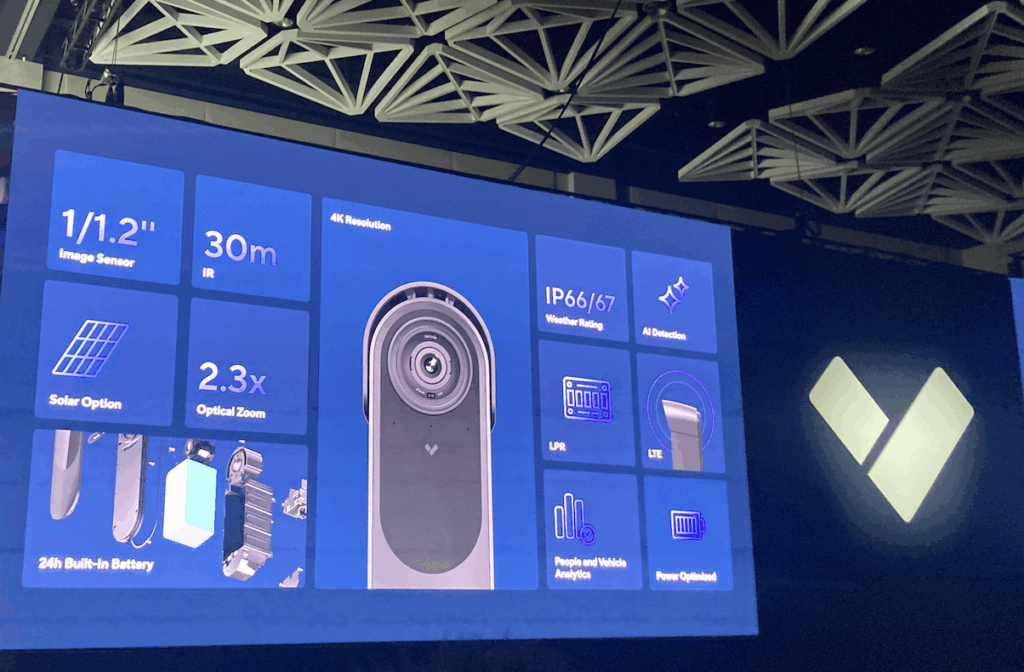
Lead Product Manager Manuel Castro presented the CR63-E remote camera, which integrates power, connectivity and imaging for off-grid locations. Its purpose is straightforward: to extend surveillance to places that were previously difficult or expensive to monitor.
Director of Product David Zhai unveiled Verkada’s latest intercoms, now featuring real-time translation with subtitles. This not only allows cross-language conversations but can also translate them on the fly. Zhai also highlighted Visit Key credentials, designed to simplify visitor access, alongside new facial recognition capabilities.
Alarms were the focus for Andrew Bowers, VP of Product. He introduced the compact BP32 wireless panel. A demonstration of personalised voice alerts – where the system could even describe the trespasser’s appearance as it detected him or her – illustrated how AI is changing deterrence as well as detection.
Access control updates came from Senior Director of Product Jake Leichtling. Now in its fifth year at Verkada, this line has grown to include mobile credentials and the new Face Unlock feature. The standout announcement was the AF64 Access Station Pro, a device that combines controller, reader, touchscreen and camera in one, reducing the need for complex installation. A new wireless lock series further emphasised Verkada’s aim of making access control simpler and more adaptable.
Command and Control
All of these innovations tie back into Verkada Command, the cloud-based software that manages devices across sites. Command continues to expand, with new analytics dashboards for retail and attendance, tools for camera health monitoring, and an updated incident response module for visitor management. Integrations via Helix are also deepening, allowing video to be combined with external data like point-of-sale systems for richer context in investigations.
The integration of the Verkada products theme ran throughout. Whether it was visitor management linking with video, alarms working alongside access control, or trailers extending surveillance beyond fixed perimeters, the demonstrations showed joined-up workflows rather than isolated products. And AI was presented not as a distant promise but as a working capability, already embedded into how the system operates.
What This Means for the Security Industry
VerkadaOne made it clear where the company believes physical security is heading. The shift is from retrospective analysis to anticipating – and knowing – what is happening now. Customers increasingly expect systems that are unified, easy to deploy and intuitive to operate.
Hardware is being reimagined for new environments, from solar-powered trailers to LTE-enabled remote cameras. These developments point to a future where security coverage extends far beyond traditional building perimeters.
User experience is also becoming central. Features like face unlock, mobile credentials, and streamlined visitor management reduce friction and enhance usability, while AI-driven analytics promise efficiency gains for overstretched security teams.
Yet there is also a caveat. The growing use of facial recognition, language translation and predictive analytics will raise questions around privacy, regulation and trust. These issues were not in focus on stage, but they will inevitably follow as deployment widens.
For now, Verkada has staked its claim. Cloud is no longer the differentiator – it is the foundation. The new competitive edge lies in AI, and Verkada clearly wants to lead that frontier.