





By John Lutz Boorman, Head of Product and Marketing, Hanwha Vision Europe
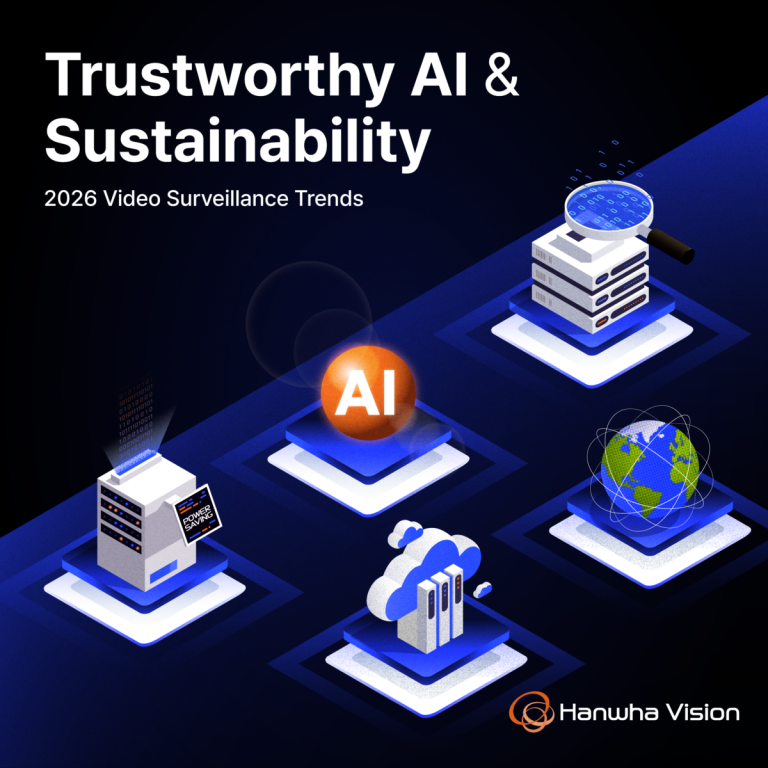
In recent years, the development and adoption of AI technology has accelerated at an unprecedented pace, impacting various industries. Of course, the spark of innovation provided by AI is already a feature of the video surveillance sector. However, Hanwha Vision predicts that 2026 will be a pivotal turning point for AI.
We foresee AI moving beyond simple adoption to becoming the essential foundation of the entire industry – the emergence of so-called ‘Autonomous AI Agents’ will reshape the structure and operations of video surveillance systems.
To meet this wave of change, Hanwha Vision has identified five key trends that the industry must focus on. These trends signal a future where AI serves as the core engine, elevating video surveillance further from monitoring to providing central pillars of operational efficiency and sustainability.
1: Trustworthy AI: Data Quality and Responsible Use
As AI analysis becomes ubiquitous, the principle of ‘Garbage In, Garbage Out’ will be critical in video surveillance. Visual noise and distortion caused by challenging environments – such as low light, backlighting or fog – are primary causes of AI-derived false alarms. In 2026, establishing a ‘Trusted Data Environment’ to solve these issues will become the industry’s top priority.
With the performance of AI analysis engines levelling up across the board, the focus of investment is shifting towards securing high-quality video data that AI can interpret without error.
An example of this is minimising noise and distortion in extreme environments through AI-based high-performance ISP (Image Signal Processing) technology and the use of larger sensors. AI-based ISP employs deep learning to differentiate between objects and noise, effectively eliminating noise while optimising object details to provide real-time data most conducive to AI analysis. Larger image sensors capture more light, which fundamentally suppresses video noise generation, starting from low-light conditions.
In parallel, as the ethical use of AI becomes a major concern, the mandatory adoption of AI governance systems is approaching. The EU’s AI Act uses a risk-based classification of AI systems deployed in public spaces and imposes a legal obligation on manufacturers to ensure transparency in AI from the design phase, which can only accelerate the industry’s push to build genuinely trustworthy AI.
Hanwha Vision’s 2nd Generation P Series AI cameras feature a dual NPU design, the Wisenet 9 chipset with AI-based image enhancement, and a large 1/1.2-inch sensor, guaranteeing crystal-clear images optimised for AI analysis even in the harshest environments.
To enhance its reputation for trusted AI, in 2026 Hanwha Vision plans to upgrade its WiseAI app, leveraging its capabilities in trusted data acquisition. An Auto Calibration feature will determine the distance information of a scene to enhance data reliability, and new AI event features will analyse abnormal behaviours such as fighting and falling. These will be included in the company’s 2026 product releases.
2: The AI Agent Partnership – From Tool to Teammate
As AI evolves from straightforward detection to an agent capable of analysing complex scenes and proposing initial responses, the role of the operator will change fundamentally. Humans will delegate repetitive surveillance tasks to AI Agents, freeing themselves for more critical, high-level activity.
While previous AI systems in video surveillance merely reduced the operator’s workload by automating repetitive tasks such as object search, tracking and alarm generation, the AI Agent will be able to take this a step further. It will autonomously conduct complex situational analysis, automatically execute an initial response, and recommend the most effective follow-up actions to the monitoring operator.
For example, an AI Agent can independently assess an intrusion, initiate preliminary steps such as sounding an alarm, and then propose final decision options – such as whether to call the police – to the operator. Simultaneously, it can automatically generate a comprehensive report detailing real-time video of the intrusion area, access records, a log of the AI’s initial actions, and suggested optimal response strategies.
Operators will become more like commanders, making final decisions that require nuanced judgement, complex analysis and consideration of legal and contextual implications. They will also take on the role of AI governance manager, transparently tracking and supervising all autonomous actions and reasoning processes executed by the AI Agent. This essential function, which prevents system misuse, demands a significant elevation of the monitoring operator’s skill set.
3: Driving Sustainable Security
The explosive growth of generative AI is driving demand for energy. According to the International Energy Agency (IEA), power consumption by data centres will more than double by 2030 under its base-case scenario, driven by demand for AI.
The video surveillance industry can no longer prioritise performance without limit, as it faces the dual challenge of surging high-resolution video data and the computational burden of AI at the edge. As such, ‘sustainable security’, which prioritises operational longevity and minimising environmental impact, is set to become a core competency for achieving TCO (Total Cost of Ownership) reductions and meeting ESG goals.
To realise sustainable security, the industry is moving towards developing low-power AI chipsets that drastically reduce power consumption while preserving high-quality imaging and AI processing power. It is also prioritising technologies that ensure data efficiency directly on the edge device, such as the camera.
For instance, Hanwha Vision’s AI-based WiseStream technology maximises video data management efficiency, contributing to lower power consumption. It does this by intelligently separating regions of interest from non-interest areas within a scene and adjusting the compression ratio accordingly. This maximises data traffic efficiency while securely retaining all necessary information. What’s more, cameras equipped with Wisenet 9 have improved baseline data transmission efficiency as they reuse images from static regions.
4: Smart Spaces Powered by Video Intelligence
As AI is integrated into cameras and advances are made in cloud technology for large-scale data processing, the concept of a ‘Sentient Space’ – a space that can sense and understand – is becoming a reality.
This sees video surveillance expanding beyond simple monitoring to become a core data source for ‘Digital Twin’ technology, which reflects the physical environment in real time. A Digital Twin is a virtual replica of a real-world physical asset, created in a computer-based virtual environment.
Currently, the AI information (metadata) extracted by AI cameras is already used as business intelligence to optimise operations in sectors such as smart cities, retail and advanced manufacturing. Moving forward, this metadata will be fused with diverse information from access control devices, IoT sensors and environmental sensors to create a unified, intelligent Digital Twin environment.
This Digital Twin environment will revolutionise the monitoring experience. Instead of complex, fragmented screens, operators will gain a holistic view of event relationships on a map-based interface that integrates the VMS (Video Management System) and access control systems. Within this mirrored digital space, the video system will eventually evolve into an Autonomous Intelligent Space that deeply understands situations and manages and resolves issues independently.
Adding the latest AI technology could provide security managers and operators with greater control over system operations. For example, AI can instantly comprehend natural language questions such as, ‘Find a person who entered the server room after 10pm last night’, and automatically analyse access and video records to report the results. This signifies true situational awareness that moves far beyond complex search parameters.
5: Hybrid Architecture: The Distributed Power
The rising cost of transmitting high-definition video data, coupled with data sovereignty and regulatory concerns, poses challenges for purely cloud-based systems. As such, ‘hybrid architecture’, which preserves the benefits of the cloud while mitigating operational strain, is rapidly establishing itself as the optimal solution for the video surveillance sector.
Hybrid architecture grants users control and flexibility over system operations. Because it allows system functions to be deployed to the most efficient location based on an organisation’s business needs, budget, and legal or regulatory environment, it will become a key strategy for maximising TCO.
From a video surveillance standpoint, hybrid architecture maximises efficiency by flexibly distributing functions between on-premises and cloud environments. On-premises environments can host real-time monitoring and critical functions that must comply with regulations for short-term video storage and retention. Functions involving the local processing and control of highly sensitive data are also placed on-premises to bolster data security and ensure immediate response capabilities.
Meanwhile, the cloud environment is leveraged for functions such as remote centralised management, large-scale data analysis, deep learning for AI models, and long-term archiving. Using the cloud in this way ensures system scalability and operational ease.
Beyond simple infrastructure separation, this architecture also supports the optimal distributed computing structure required for AI-analysis-based video surveillance systems.
In this structure, edge devices such as cameras and NVRs handle the first layer of computation, performing real-time detection and transmitting only necessary data to the cloud. This reduces network bandwidth strain while maximising speed and storage efficiency. The cloud environment then conducts the second layer of deep analysis and large-scale machine learning based on the filtered data from the edge, significantly enhancing the accuracy and sophistication of AI functions.
In 2026, I believe AI will be firmly established as a new standard for security infrastructure. To meet this shift, Hanwha Vision will deliver trustworthy data and sustainable security value by providing solutions based on a hybrid architecture optimised for AI analysis and processing. It looks set to be an exciting year!