
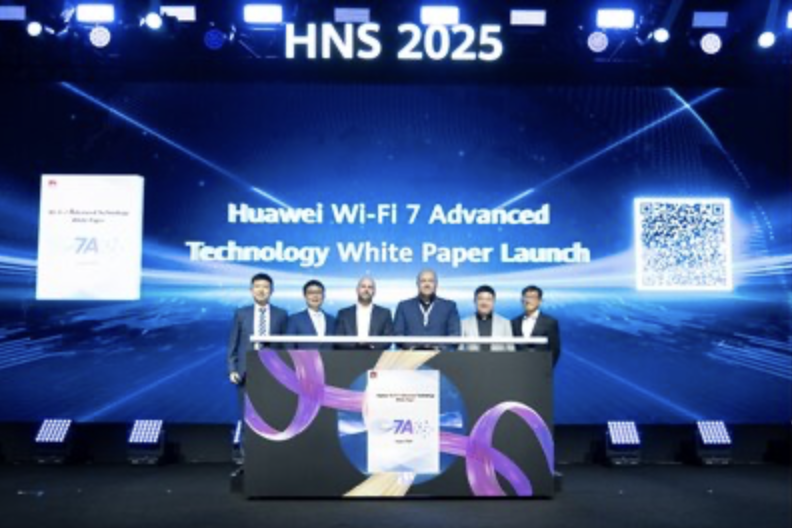
At the Huawei Network Summit 2025 in Munich, Huawei, together with the IEEE and several industry pioneers, unveiled the Wi-Fi 7 Advanced Technology White Paper for Europe. This release goes beyond the promise of faster connections. It introduces a vision for networks that are not only quicker but also inherently secure and intelligent — a development with significant implications for the physical security industry.
The white paper details the evolution of Wi-Fi 7 into a platform that combines communication, sensing, and protection. It describes breakthroughs such as 80 MHz continuous multi-AP networking, integrated Wi-Fi and IoT capabilities, and full-scope security systems that use AI to safeguard data and spaces. These features could transform how surveillance, access control, and building management systems communicate and respond in real time.
Huawei’s collaboration with IEEE lends weight to the initiative. As Dr Edward Au, IEEE 802.11be (Wi-Fi 7) Technical Editor, explained, “Wi-Fi 7 Advanced enables APs to create campus networks that seamlessly integrate communication, sensing, and IoT. This enhances campus experience, strengthens security, and boosts digital productivity.”
Smarter, Faster, More Secure
Wi-Fi 7 Advanced enables high-speed connections of up to 10 Gbps, supporting bandwidth-intensive applications such as cloud-managed CCTV, AI-powered analytics, and edge computing. For security operators, this means real-time data transfer without latency issues — a critical factor for live monitoring, facial recognition, and incident response.
The technology’s “full-scope security” extends protection from the digital layer to the physical environment. Huawei’s Wi-Fi Shield, for instance, uses AI-powered signal scrambling to prevent data interception, while Channel State Information (CSI) sensing can detect anomalies in the wireless environment — effectively allowing the network to sense unauthorised movement or device interference. In secure facilities or critical infrastructure, this creates an additional layer of situational awareness.
Wi-Fi 7 Advanced also integrates environmental sensing. Networks can detect human presence, occupancy, and even subtle motion using millimetre-wave (mmWave) signals. When linked with building management or security systems, this capability could automate lighting, access control, or alarm responses based on real-time occupancy. For example, a restricted area could automatically trigger alerts if movement is detected after authorised hours.
By combining communication, sensing, and IoT, Wi-Fi 7 Advanced helps security installers and facility managers reduce deployment complexity. Huawei’s SD-IoT framework supports faster setup and unified device management, meaning less physical wiring and easier integration between surveillance, access, and environmental systems.
Why It Matters for the Security Sector
The security industry increasingly depends on robust, intelligent connectivity. As more devices move to cloud platforms and rely on AI analytics, network reliability and cyber resilience have become inseparable from physical protection. Wi-Fi 7 Advanced directly addresses these priorities.
For installers and integrators, this evolution could simplify system design — enabling one wireless infrastructure to support video surveillance, intrusion detection, and environmental monitoring simultaneously. For end users, it offers the reassurance of “zero-trust” wireless security, where each connection is verified and monitored in real time.
Huawei’s Xinghe AI Campus showcases what this next-generation connectivity looks like in practice. According to Shawn Zhao, President of Huawei’s Campus Network Domain, “Wi-Fi 7 Advanced delivers full-scope security from the digital world to physical spaces, creating efficient, intelligent, and secure campus networks for enterprises.”
Europe’s inclusion in this white paper release also signals a strategic focus on the region’s digital transformation agenda. As governments and organisations prioritise sustainability, energy efficiency, and cyber resilience, Wi-Fi 7 Advanced provides the technological foundation to deliver on those goals. Its ability to integrate connectivity, sensing, and protection could prove essential for smart cities, healthcare environments, and educational campuses — sectors where security and connectivity are increasingly intertwined.
Ultimately, Wi-Fi 7 Advanced marks the start of a new phase in networked security. It positions wireless connectivity not just as a data carrier but as an active guardian of physical and digital spaces — an important step toward more intelligent, self-aware infrastructure.
For more details, visit Huawei’s page: https://e.huawei.com/en/material/enterprise/3101308b40b6473aba04123400c50c78.